Real-time separation
Time-critical tasks execute in an out-of-band stage separate from ordinary Linux scheduling.
LINRT REAL-TIME LINUX DISTRIBUTION
Xenomai 3 dual-kernel real time, RTDM and legacy migration
Choose Cobalt when the application requires a dedicated high-priority real-time stage, Xenomai 3 semantics or a migration path for existing real-time software and device drivers.
01 / Why choose this approach?
Choose Cobalt when the application requires a dedicated high-priority real-time stage, Xenomai 3 semantics or a migration path for existing real-time software and device drivers.
Time-critical tasks execute in an out-of-band stage separate from ordinary Linux scheduling.
Build dedicated device I/O paths where normal Linux drivers cannot meet the latency budget.
Xenomai libraries and selected emulation skins support migration from Xenomai and legacy RTOS software.
Relevant for control and fieldbus stacks requiring validated deterministic communication paths.
02 / How the architecture works
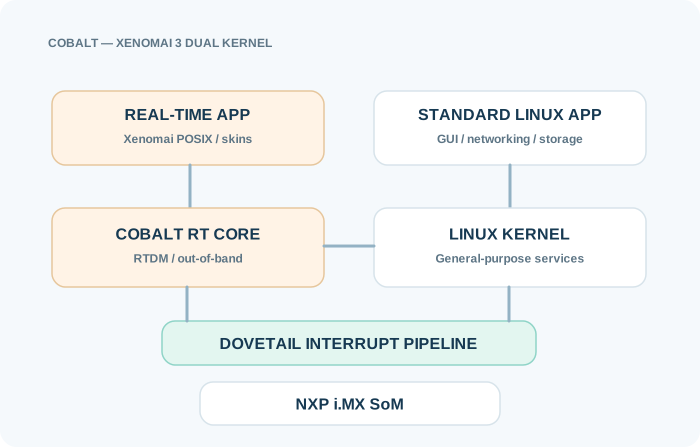
Cobalt combines the Xenomai 3 real-time core with a Linux kernel equipped with a compatible interrupt-pipelining interface such as Dovetail on supported branches. Real-time threads and RTDM handlers run out-of-band; Linux continues to deliver ordinary networking, storage, graphics and administration.
03 / Engineering considerations
04 / BSP portfolio & SoM targets
LinRT 5.3 is planned for Q4 2026 as the CRA-Ready evolution of the LinRT 5.x LTS family, on Yocto 5.0 Scarthgap LTS. BSP security controls and traceable validation evidence are the delivery goals; the separate customer CRA Certification Kit is planned for early 2027 alongside LinRT 6.x LTS.
LinRT 6.x LTS is planned for Q1 2027, targeting Yocto 6.0 Wrynose LTS, Linux 6.18 LTS and Qt 6.12 LTS. NXP i.MX95 SoM support is announced as part of this generation, subject to configuration-specific qualification.
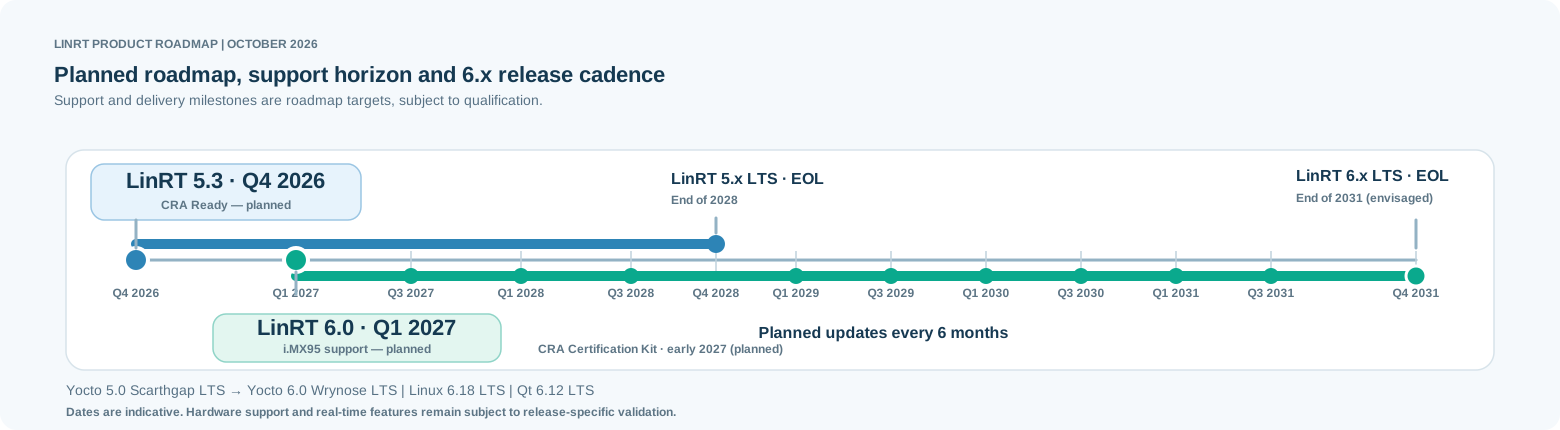
LinRT 5.x LTS uses Yocto Project 5.0 “Scarthgap” LTS, with Linux 6.6 / 6.12 LTS variants according to target and distribution. LinRT 5.3 (product version, not Yocto 5.3) is planned for Q4 2026 as CRA Ready.
LinRT 6.x LTS is planned for Q1 2027, targeting Yocto Project 6.0 “Wrynose” LTS, Linux 6.18 LTS and Qt 6.12 LTS. Support for NXP i.MX95 is planned with this release, subject to qualification for each BSP variant.
05 / CRA readiness
The proposed LinRT CRA-Ready BSP and CRA Certification Kit aim to make product-level cybersecurity assessment more repeatable, with evidence tied to a defined software image and hardware configuration.
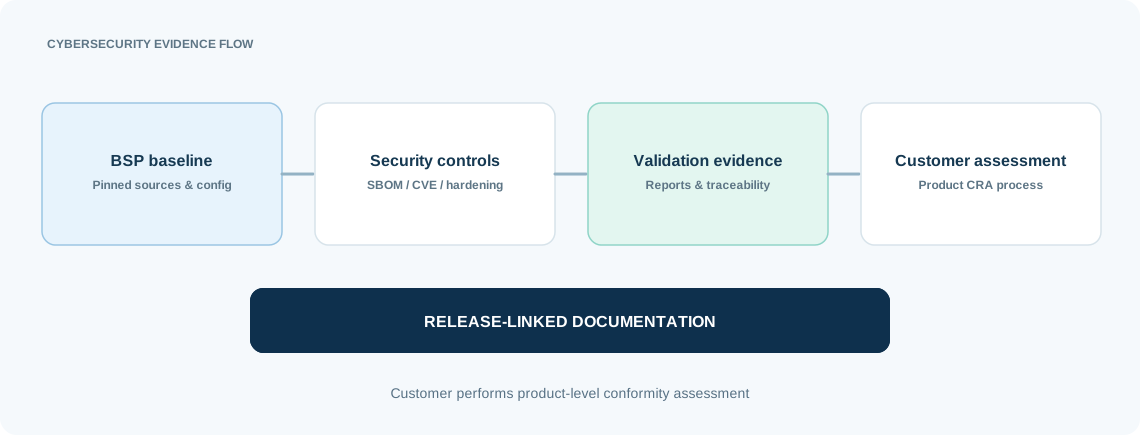
Planned for early 2027 alongside the initial LinRT 6.x LTS release, the CRA Certification Kit is designed to help manufacturers turn BSP-level cybersecurity controls into traceable evidence for their own product conformity assessments.
Software Bill of Materials, CVE/VEX workflows and component traceability for a defined BSP build.
Reusable hardening checks, boot and update assessments, and repeatable validation procedures.
Requirements-to-tests mapping, result templates and evidence package structures for customer integration.
The Kit supports a product-specific Cyber Resilience Act conformity process; it is not a CRA certificate and does not replace the manufacturer’s risk assessment or legal responsibilities.
06 / Explore another edition
Threaded interrupt handling, preemptible kernel paths and standard POSIX / Linux APIs. The simplest route when latency targets can be met within the Linux ecosystem.
Explore the distribution →A separate high-priority real-time execution stage with mature Xenomai APIs, RTDM drivers and optional compatibility skins for selected legacy applications.
Explore the distribution →Dovetail connects Linux and the EVL core; libevl exposes dedicated real-time services to C/C++ applications requiring predictable out-of-band execution.
Explore the distribution →Discuss SoM support, system integration, real-time driver architecture and the scope of the LinRT CRA-Ready roadmap.
Technical references
Technical baseline and upstream documentation used for this presentation. Product scope and availability must be confirmed with LinRT.